
Nobody Warns You About the Legs. Standing Still Is Harder on Them Than Walking.
One nurse described her own day like this: fine at work, maybe a little sore, and then she gets home, takes her socks off, gets into bed, and her feet and legs suddenly start to ache. She wakes up the next morning and it is still there. If your job keeps you in one spot, here is the physiology behind that, and why the answer is almost never another pair of shoes.

Your Calf Is a Pump and Standing Still Switches It Off
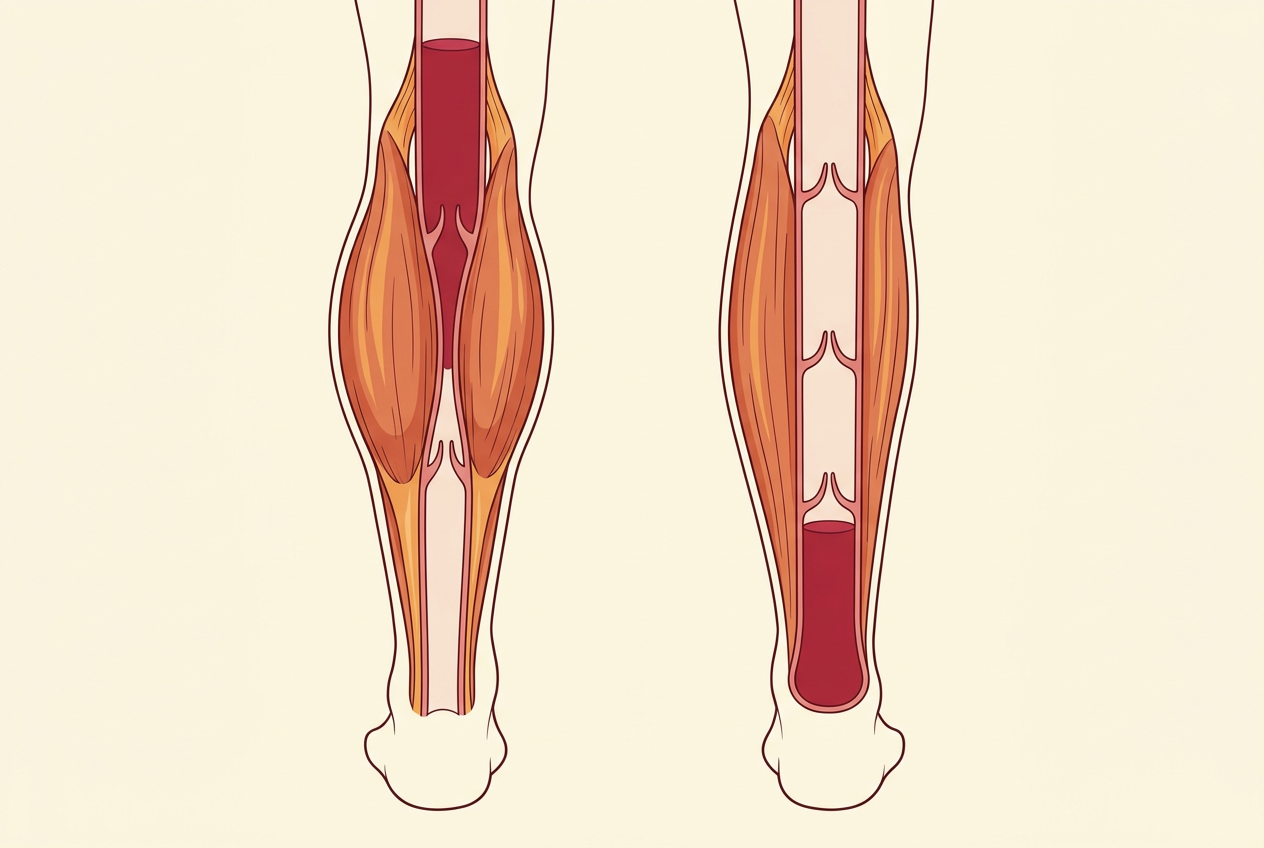
Blood gets down to your feet easily. Gravity does it for free. Getting it back up is the part nobody explains, and the leg does not have a second heart to do it with. What it has instead is your calf.
The deep veins in your lower leg run straight through that muscle, and they are fitted with one way valves. Every time the calf contracts it squeezes those vessels flat and pushes their contents up toward the knee. The valves stop it sliding back down again.
Walking works that pump every single step. Standing still does not work it at all. The muscle is loaded, braced and holding you upright, which feels like effort and is effort, but it is a static contraction rather than a rhythmic one, and a pump that never releases is not pumping. Gravity keeps doing its half of the job for eight hours while the return half is idle.
When return slows, fluid that should be moving upward sits out in the tissue instead. That is the heaviness. That is why your ankles come up over the tops of your shoes by four o'clock and why the same shoes went on fine at breakfast. A pump that stopped running needs a contraction it did not have to generate for itself, which is the job the SculptWave does with EMS microcurrents that contract and release the muscle from the inside.
The Same Shift Costs More Than It Did at Forty
Nothing about your job changed. The number of hours did not change. What changed is the tissue doing the work.
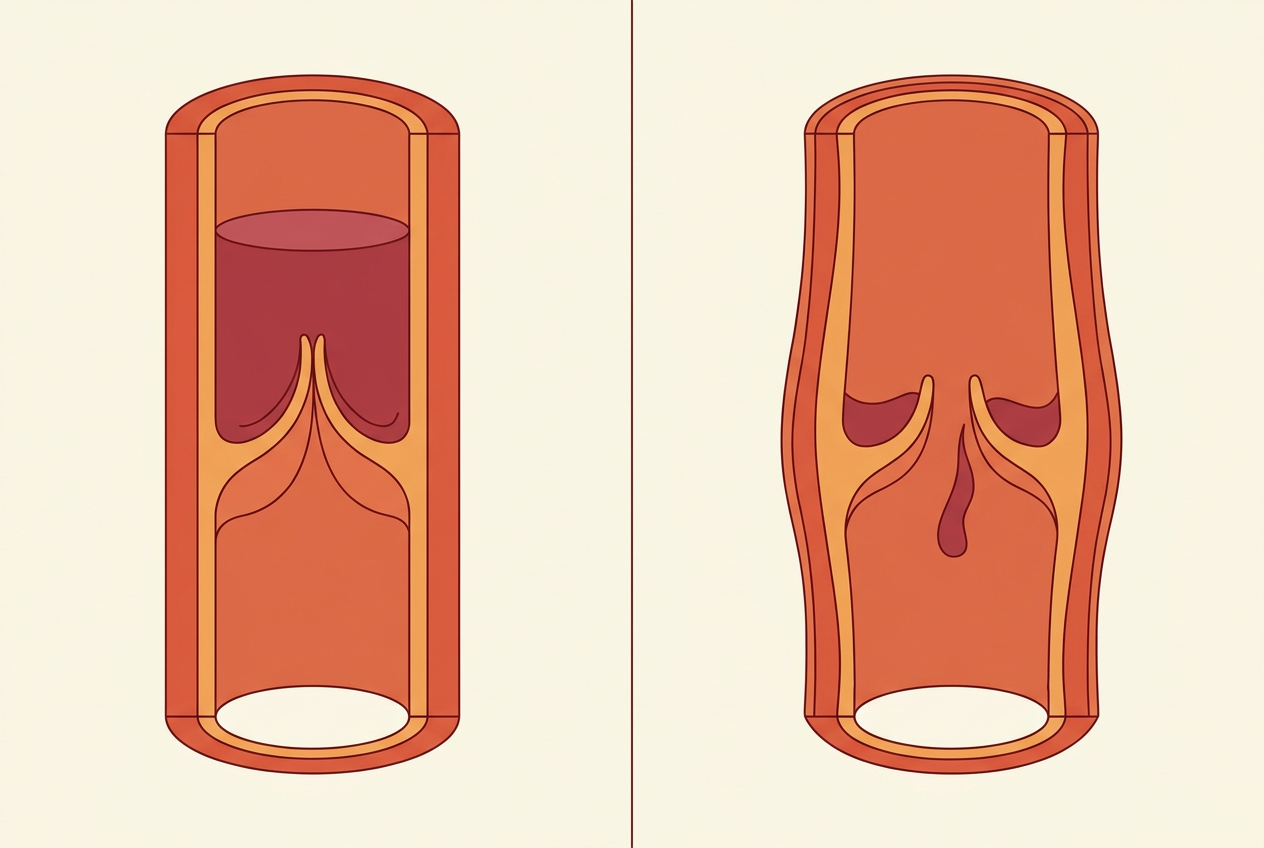
Vein walls and the small valve leaflets inside them are elastic structures, and elastic structures get less springy with time. A valve that no longer closes cleanly lets a little of each push slide back down, so the calf has to move the same fluid more than once. At the same stage of life, falling estrogen reduces the pressure driving lymphatic flow, and lymph is the system responsible for clearing what has already leaked out into the tissue. Both halves of the return get quieter at once.
The connective tissue changes alongside them. Fascia is a continuous sheet that wraps the calf and runs down through the sole of the foot, and it is built to glide as the shape underneath it changes. Hold a body in one position for eight hours and the same fibres stay loaded in the same direction all day, every day, and the sheet stops sliding freely over what it wraps. That is the stiffness you feel in the first few steps rather than in the last few.
- Standing on one square of floor rather than covering ground
- Hard flooring, which fixes the foot in one position instead of letting it vary
- Heat, which widens vessels and slows return further
- A long drive or a long flight straight after a shift
- Sitting down to recover, which switches the pump off just as thoroughly as standing
That last one is worth sitting with. Putting your feet up feels like the opposite of standing all day, and for pressure in the foot it is. For the pump it is the same instruction: do nothing. Tissue that has stiffened and a pump that has gone quiet want warmth so the fascia will give and then a contraction from outside, which is the pairing the SculptWave puts into one handheld tool.
What Actually Moves It Happens in an Order
Three things have to happen to a leg that has been held all day, and the order is not optional. Warmth first. Cold, guarded tissue resists, and warming it through is what lets the fascia give at all. Skip it and the work starts against a leg that has not agreed to it yet.
Direction second. Fluid in the leg is not going to be shaken loose, it has to be taken somewhere. The route runs upward, from the ankle toward the hollow behind the knee, where there is a cluster of lymph nodes, and on toward the groin crease. Work it in that direction and you are working with the plumbing. Buzz at it in place and you are agitating fluid that has nowhere to go.
Contraction third, and this is the step with no substitute. The pump only runs when the muscle contracts and releases, and if she has been standing in one spot all day, that is exactly what has not happened. EMS microcurrents contract and release the muscle from the inside, which can give the calf the kind of contraction walking would have given it. It asks nothing of a woman who has been on her feet since seven in the morning.
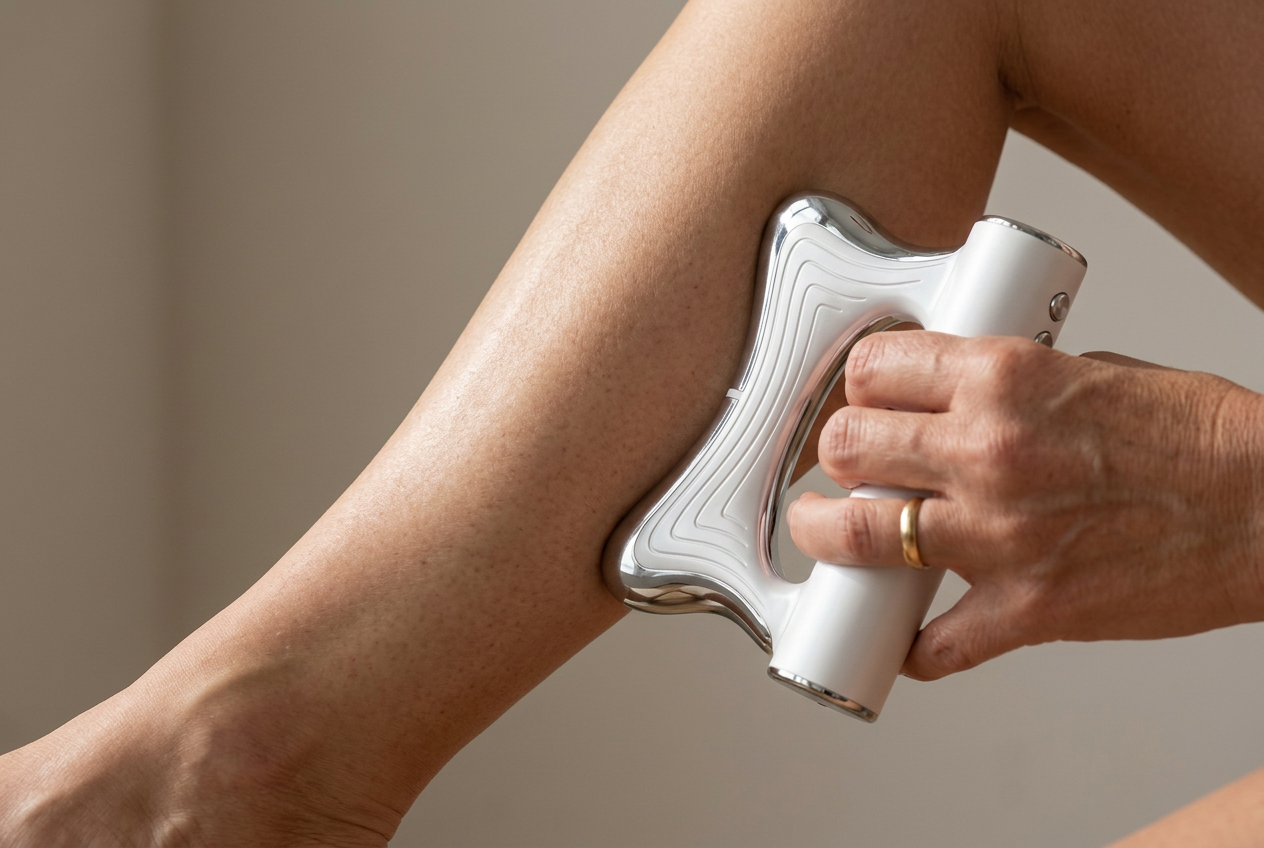
Shape decides whether any of it lands. A calf is a curve and a shin is a hollow beside a bone, and a flat surface bridges across both, touching at two points and missing everything between them. Press anything flat against your own calf and look at the edges. The gap is the whole problem.

Shoes and Socks Are Solving a Different Problem
Every conversation in this territory is a shoe conversation. One nurse put it plainly: dropping a hundred and fifty on a shoe that does not work is killing my wallet, spam me with all suggestions, I am desperate.
Here is the honest version. A good shoe and a rubber mat work on what happens under your foot: impact, pressure, how hard the ground is, and that is a real problem they are a real answer to. Neither one has any mechanism at all for what happens up the leg. There is nothing in a shoe that contracts your calf for you.
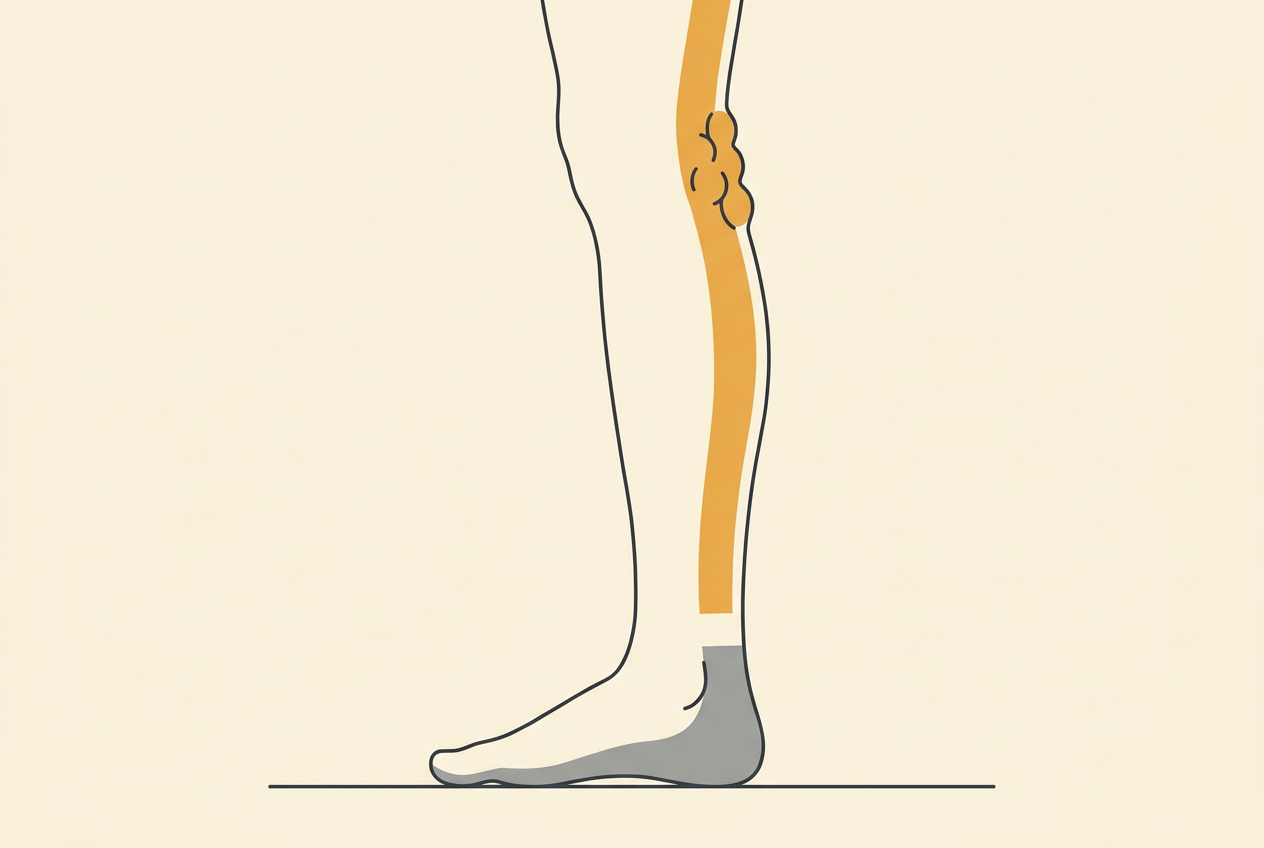
Compression deserves more credit than it usually gets, and women who wear it say it works. What it does is apply external pressure that makes it harder for fluid to leave the vessels in the first place, which is genuinely useful. It is not the same job as moving what is already out in the tissue, because a sock has no direction and no contraction in it. You can squeeze a rolled towel all day, and when you let go it is exactly the same towel.
- Cushioned shoes and mats change impact under the foot, not return up the leg
- Compression resists fluid leaving the vessel, it does not move what already left
- Rolling on a ball reaches the sole, which is one end of a much longer chain
- Elevation uses gravity for a while and stops the moment you stand up
- Rest removes the load and still leaves the pump switched off
None of that means she has been wasting her time. She has been doing the right thing to the wrong end of the leg with a tool that was never built for it. Plenty of women are already standing on a tennis ball after work, which is the correct instinct performed with the only object in the house. The behaviour is not the thing that needs changing.
What Does Not Clear Tonight Is Where Tomorrow Starts
Notice when it actually hurts. Not at eleven in the morning with three clients waiting. It arrives when she stops, and the sentence that keeps repeating is the second half of it: she wakes up in the morning and it is still there.
That is the part that decides how the next few years go. A leg that clears overnight starts the next shift at baseline. A leg that does not clear starts already carrying yesterday, so the same eight hours arrive on tissue that began the day loaded.
Do that five days a week for a decade and the ceiling is not pain, it is capacity. Women in standing work rarely stop because they cannot do the work. They stop because they cannot stand through it, and they start handing the last appointment of the day to somebody else.
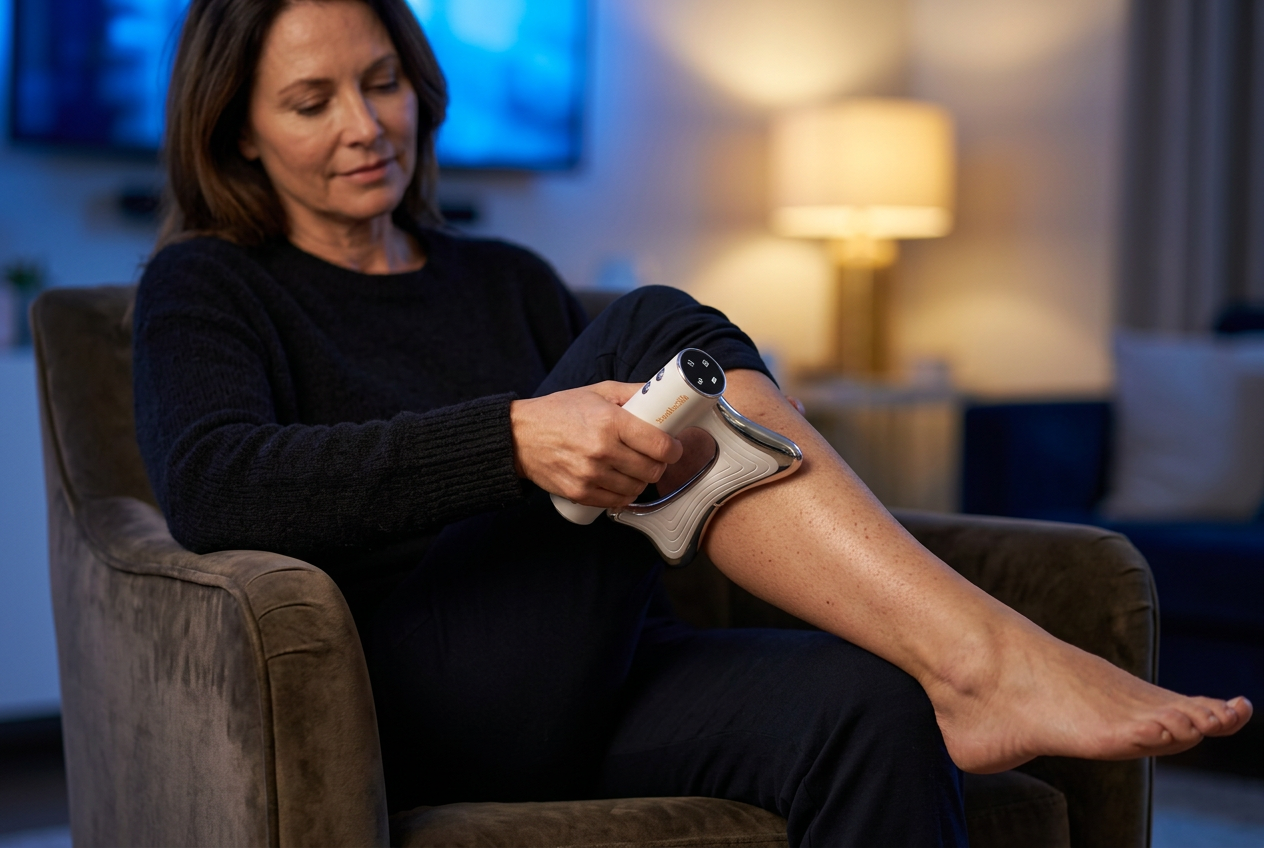
Ten minutes at the end of the day is not a wellness project. It is warmth, then a stroke that travels the right way, then a contraction the day never gave you, on the one part of the body that has to move everything else back upward and got no help doing it. It happens while the television is on, and a leg that goes to bed clearer can start tomorrow closer to zero.
The Contraction Your Calves Did Not Get Today
Don't Miss Our Summer Relief Sale. For a limited time, enjoy 55% off the SculptWave Full Body Contouring Device, plus a complimentary 20-page Self-Care Guide with every order.
Check Availability →
What Others Are Saying About SootheSilk
Individual experiences shared by verified customers. Results vary from person to person.
“I am on a salon floor nine hours a day and I do not walk anywhere. Ten minutes a night on each calf while the television is on, and by the third week my shoes went on at night the same way they went on in the morning.”
“I wore compression under my scrubs for years and it did help, but the relief only came when I took them off. This is the first thing I have used that does something to my legs instead of holding them.”
“The heat is the part I did not expect to matter. I tried it once without waiting for it to warm up first and I may as well have been rubbing a cold leg. Give it the first minute and it is a different thing entirely.”